rLLM's Main Components
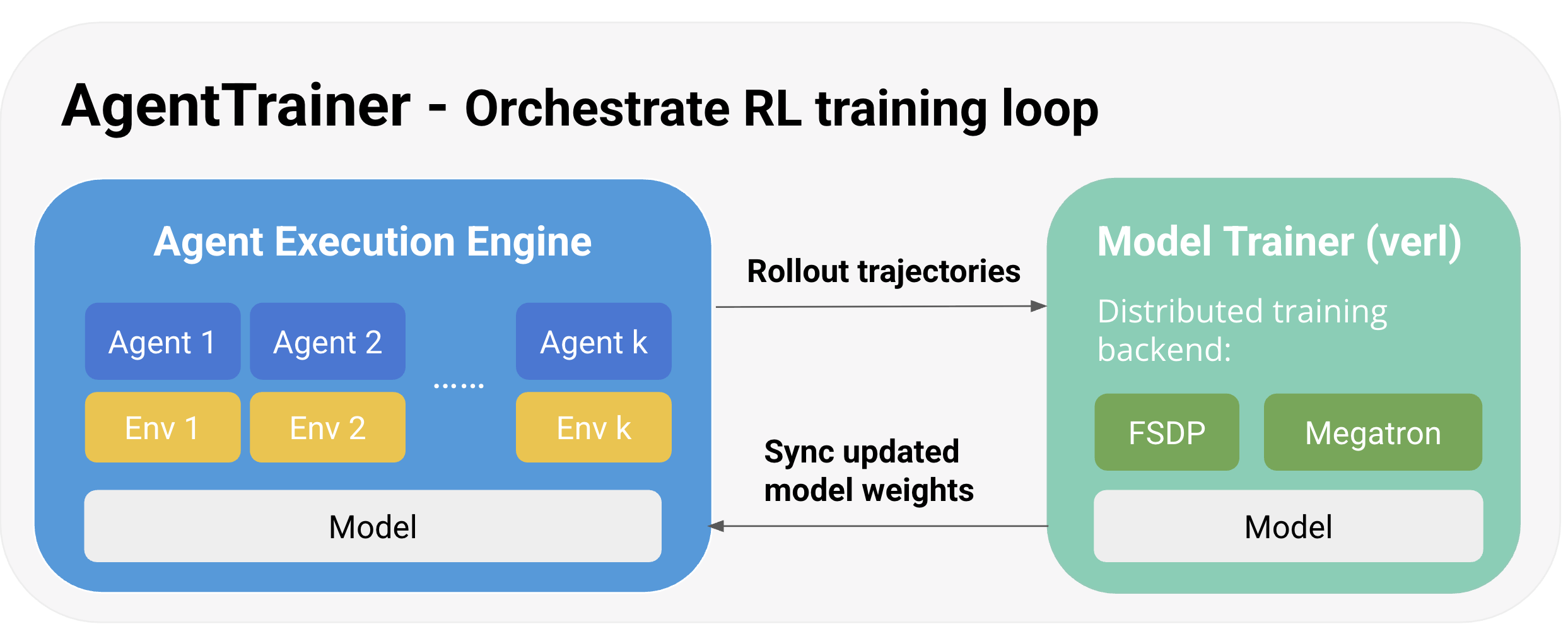
A typical RL system consists of two components:
- Sampler: Generates trajectories from the current policy (i.e., the agent).
- Trainer: Computes gradients from the sampled trajectories and updates the policy.
In online RL, this forms a closed training loop:
- The sampler generates a batch of trajectories using the current agent.
- The trainer updates the agent’s weights using those trajectories.
- A new batch is generated using the updated agent, and the cycle repeats.
In rLLM, we design multiple components to implement the training loop in a modular way:
BaseAgentandBaseEnvclass that user can easily extend to build their custom agents and environmentsAgentExecutionEnginethat orchestrates the interaction between agent and environment for parallelized and fully async trajectory generation.AgentTrainerthat orchestrates the RL training loop between the sampler (AgentExecutionEngine) and the model trainer (verl).
Below, we explain in more details how each components works, and show examples on how to use them.
I. Agent and Environment Abstractions
rLLM provides simple, modular interfaces for defining custom agents and environments. Users can quickly prototype new agents and environments with minimal boilerplate. Check out the examples below to get started building your own agentic workflows.
-
Example: A math agent that can self-correct its answer each turn.
class MathAgent(BaseAgent): def __init__(self, accumulate_thinking=True): self.instruction = "Let's think step by step, and put your final answer within \\boxed{}." self._trajectory = Trajectory() self.messages = [] self.accumulate_thinking = accumulate_thinking def update_from_env(self, observation, reward, done, info, **kwargs): if not self.trajectory.steps: question = observation["question"] formatted_observation = f"{question} {self.instruction}" else: formatted_observation = "Your previous answer may contain a mistake. Please review it." self.messages.append({"role": "user", "content": formatted_observation}) def update_from_model(self, response, **kwargs): self.messages.append({"role": "assistant", "content": response}) new_step = Step(chat_completions=copy.deepcopy(self.chat_completions)) self.trajectory.steps.append(new_step) return Action(action=response) def reset(self): self._trajectory = Trajectory() self.messages = [] @property def chat_completions(self): messages = copy.deepcopy(self.messages) if not self.accumulate_thinking: for msg in messages[:-1]: if msg["role"] == "assistant": _, sep, after = msg["content"].partition("</think>") if sep: msg["content"] = after return messages @property def trajectory(self): return self._trajectory def get_current_state(self): assert self._trajectory.steps return self._trajectory.steps[-1] -
Example: Base environment class
class BaseEnv(ABC):
    @abstractmethod
    def reset(self) -> tuple[dict, dict]:
        pass

    @abstractmethod
    def step(self, action: Any) -> tuple[Any, float, bool, dict]:
        pass

    def close(self):
        return

    @staticmethod
    @abstractmethod
    def from_dict(info: dict) -> "BaseEnv":
        raise NotImplementedError("Subclasses must implement 'from_dict'")
II. AgentExecutionEngine for Agent-Environment Orchestration
At the heart of this architecture is the AgentExecutionEngine, a high-performance sampler that:
- Orchestrates interactions between agents and environments
- Supports fully asynchronous, parallel trajectory rollout
During RL training, AgentExecutionEngine integrates seamlessly with the trainer to support RL algorithms like GRPO, PPO, and beyond.
-
Example: Using
AgentExecutionEnginefor trajectory collectionengine = AgentExecutionEngine( agent_class=ToolAgent, agent_args={"tools": ["python"], "parser_name": "qwen"}, env_class=ToolEnvironment, env_args={"tools": ["python"], "reward_fn": math_reward_fn}, engine_name="openai", rollout_engine_args={"base_url": "http://localhost:30000/v1"}, tokenizer=AutoTokenizer.from_pretrained("Qwen/Qwen3-4B"), sampling_params={"temperature": 0.6, "top_p": 0.95, "model": "Qwen/Qwen3-4B"}, max_response_length=16384, max_prompt_length=2048, n_parallel_agents=64, ) test_dataset = DatasetRegistry.load_dataset("aime2024", "test") tasks = test_dataset.repeat(n=8) # For pass@k evaluation results = asyncio.run(engine.execute_tasks(tasks)) compute_pass_at_k(results)
III. AgentTrainer for Efficient RL Training
rLLM’s AgentTrainer exposes a simple high-level interface for users to specify their training workload and configurations, where users can easily specify the agent, environment, and training/validation dataset, and calls trainer.train() to train their agents with RL.
trainer = AgentTrainer(
    agent_class=ToolAgent,
    env_class=ToolEnvironment,
    config=config,
    train_dataset=train_dataset,
    val_dataset=val_dataset,
    agent_args=agent_args,
    env_args=env_args,
)
trainer.train()
Under the hood, the AgentTrainer uses rLLM’s AgentExeuctionEngine as trajectory sampler, **verl** as the model trainer, and uses Ray to orchestrate the control-flow between the sampler and the trainer.
-
Example: Using
AgentTrainerfor RL training@hydra.main(config_path="pkg://rllm.trainer.config", config_name="ppo_trainer", version_base=None) def main(config): train_dataset = DatasetRegistry.load_dataset("hotpotqa_combined", "train") val_dataset = DatasetRegistry.load_dataset("hotpotqa_combined", "test") tool_map = {"local_search": LocalRetrievalTool} env_args = { "max_steps": 20, "tool_map": tool_map, "reward_fn": search_reward_fn, } agent_args = {"system_prompt": SEARCH_SYSTEM_PROMPT, "tool_map": tool_map, "parser_name": "qwen"} trainer = AgentTrainer( agent_class=ToolAgent, env_class=ToolEnvironment, config=config, train_dataset=train_dataset, val_dataset=val_dataset, agent_args=agent_args, env_args=env_args, ) trainer.train()